Willard Russell
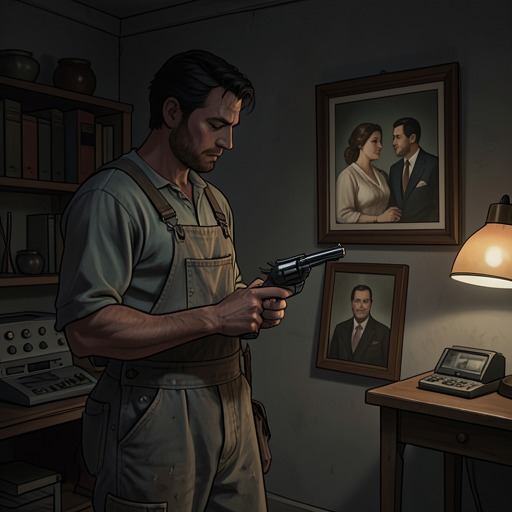
The Devil All the TimeWillard Russell is a returning soldier whose hope of settling into a home in Coal Creek is shadowed by wartime trauma and, later, by his inability to accept his wife Charlotte’s death. He is a son, husband, and father whose attempts to protect his family take the form of tenderness, religious ritual, and, at moments, lethal violence. Arvin inherits not only Willard’s German Luger but also the unanswered questions surrounding the man who carried it home.
War and Return
During the Second World War, Willard served three years in the United States Army. In the South Pacific, he and other soldiers found Gunnery Sergeant Miller Jones, a Marine left dying after being tortured by the Japanese. Unable to save him, Willard shot him to spare him further suffering. The men buried him beneath the cross on which he had been left. The experience altered Willard profoundly; the book later shows that it has not receded into the past but remains an active wound in his mind.
On the bus home, Willard drinks with two sailors and thinks that, if he reaches home, he will never leave Coal Creek, West Virginia, again. He has seen hardship in the hills where he grew up, but judges what he witnessed in the Pacific worse. His return is accompanied by drinking and contempt for the sailors, yet his attention is also fixed on the prospect of home. At a stop in Meade, Ohio, he notices a meat-loaf special advertised at the Wooden Spoon. Because his mother had made meat loaf before he left for the Army, he takes the modest sign as a hopeful one and sits down to eat.
Earskell Russell drives Willard from Ohio toward Coal Creek. During the journey, Willard speaks unusually much about a woman he met in Ohio, rather than recounting his war experiences. When he reaches Emma Russell’s house near midnight, she embraces him and weeps against his uniform. She asks what he likes about the woman, but first proposes that they thank Jesus; smelling whiskey on Willard, she does not ask him to pray with her. Willard shares her conviction that a person should approach God sincerely and not under the influence. Emma instead brings him food and coffee, including the meat loaf that had been waiting for him.
Family, Faith, and the Prayer Clearing
Willard’s relationship with Charlotte becomes the center of his life as a husband and father. When she is gravely ill, he continues to care for her in the household: he makes egg sandwiches for himself and Arvin, heats broth for Charlotte, cleans up after she becomes sick, and holds her before sitting beside her bed. The ordinary acts of service coexist with the returning memory of Miller Jones. That night Willard dreams of the Marine’s suffering, wakes before four in the morning, and cannot return to sleep.
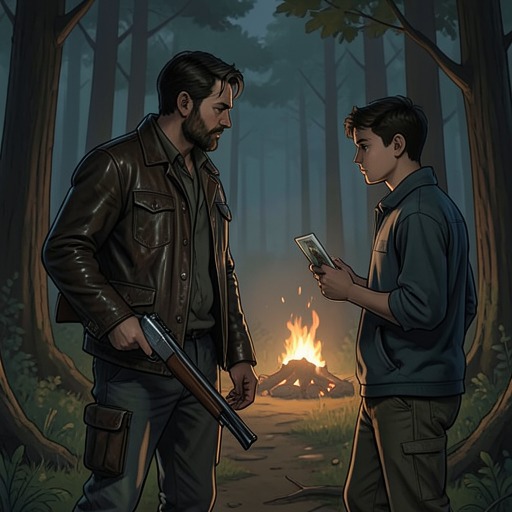
In the aftermath of that night, Willard pours his whiskey onto the ground and turns to the prayer clearing. He uses an ax, rake, and scythe to widen the space around the prayer log, clearing away brush and smoothing the ground. The following day he has Arvin help carry boards from the barn, and together they build eight crosses around the clearing, matching the original in height. Willard tells his son that doctors cannot help Charlotte but that he hopes they can save her by trying hard enough. When Arvin asks whether she will die, Willard answers that the Lord can do anything if asked properly. His faith is therefore not merely a private belief: he makes it a physical project and draws his son into it, treating labor and prayer as a means of resisting the illness.
Willard’s attachment to Charlotte also shapes what he can speak about. Years later, Earskell tells Arvin that when Willard returned from the war, questions about the Japanese led him to talk instead about the woman he had met in Ohio. Earskell never learned much about what Willard had seen on the islands. Arvin remembers that Charlotte had warned him not to question his father about the war. In the family, the subject is present through silence, nightmares, and the crosses, even when its details remain largely unspoken.
Violence and Loss
Willard’s violence is not confined to the war. One evening he watches Henry Dunlap enter his law office, drives around to the alley, and approaches the rear door with a hammer concealed beneath his shirt. When Dunlap opens the door, Willard strikes him and makes sure he is dead. He then takes deliberate steps to obscure what happened: he puts on work gloves, moves the body, rights a bookcase, gathers broken glass, wipes up spilled whiskey, and checks the office for papers bearing his name. He finds money in Dunlap’s wallet and puts it in a desk drawer, takes the keys, and hides the scotch bottle in another drawer. The scene presents a calculated effort to control the aftermath, sharply different from the care with which Willard tends Charlotte at home. The evidence here does not explain his motive for killing Dunlap, but it establishes the act and the concealment that follow it.
Charlotte’s death breaks the structure around which Willard’s prayer has been organized. For three days, neither Willard nor Arvin has returned to the prayer clearing. As darkness falls, Arvin goes looking for his father and finds him kneeling at the log. Willard has killed himself with a penknife. The clearing that he had enlarged and encircled with crosses in the hope of saving Charlotte becomes the setting for his own death. Arvin does not cry; after his mother’s long illness, he feels emptied of tears, and he leaves the woods without praying.
What Arvin Inherits
Willard’s absence continues to shape Arvin’s understanding of his father. When Arvin turns fifteen, Earskell gives him a German Luger wrapped in cloth, with a box of shells. Willard had brought the pistol back from the war; after he left for Ohio, Earskell hid it under a floorboard in the smokehouse and occasionally cleaned it. He had never used a handgun himself, but kept the weapon rather than sell it, believing Willard would want Arvin to have it. The gift links the father’s military past to the son’s coming of age, while leaving the history behind the weapon mostly untold.
The Luger also brings the silences around Willard into focus. Arvin says he never heard his father talk about military service. Earskell confirms that Willard would not discuss the war with him either, turning instead to the woman he had met at the Wooden Spoon. Arvin recognizes the restaurant as the place where Willard once took him after Charlotte became ill. The boy can assemble fragments—his father’s return, his mother’s warnings, Earskell’s recollections, and the pistol—but cannot recover a full account from Willard himself.
Arvin’s later visits to Helen Laferty’s grave with Lenora Laferty are partly driven by his search for information about Lenora’s missing father and the disabled man who accompanied him. He is fascinated by the possibility that people can vanish, and privately wishes Willard had taken that route. Lenora suggests that the two of them became orphans and came to live together as if events had arranged their meeting; Arvin insists on understanding her as a sister. When she raises the possibility of her own father returning, Willard’s story remains an unspoken measure of absence rather than a promise of reunion. His legacy reaches Arvin as a mixture of protection, inherited weaponry, religious practice, traumatic silence, and a death that leaves the son to make his way out of the woods alone.
Narrative Significance
Willard’s arc turns on the collision between devotion and helplessness. He returns from war determined to stay near home, and he gives his family practical care, but neither tenderness nor prayer can reverse Charlotte’s illness. His attempt to make faith effective takes material form in the cleared ground and eight added crosses; when that hope fails, the same place holds his final act. The recurring gap between what Willard does and what he can tell—especially about the Pacific—makes his past legible through its consequences rather than through a complete confession. Arvin inherits that gap along with the Luger, and his later questions show how Willard’s silence continues to govern the family after his death.